Socializing a Boston Terrier With Kids, Dogs and Strangers
General training information. Every dog is an individual; for health or behavior concerns, see your veterinarian.
Boston Terrier socialization is about teaching your dog that people, dogs and new places are safe and predictable. Done well, it gives you a calm companion instead of a dog who bounces off the walls or worries at every doorbell.
This guide walks through a practical plan: what you need, the steps in order, the mistakes that slow people down, and what progress can look like. It sits alongside our complete guide to Boston Terrier training, which covers the basics every socialization plan leans on.
What the Breed Brings to Socialization
The Boston Terrier Club of America (BTCA) describes the breed as intelligent, quick to learn and a companion dog that needs human contact. The club says Bostons are not outdoor dogs and will languish without people around them. That is good news for socialization, because your dog already wants to be near you.
PetMD calls the breed happy-go-lucky and sociable, and says Bostons respond quickly to positive reinforcement but can have a mind of their own. Plan for patience and short, fun sessions.
The BTCA also points to two common problems without basic training: jumping up and play nipping. Both show up fast when a sociable dog meets new people, so we build them into the plan below. Individual dogs vary, and a shy or pushy Boston is still possible.
Are Boston Terriers Good With Kids?
The BTCA says Boston Terriers do well around children, adults and even other pets. That is a helpful starting point, but it describes the breed in general, not your dog. A puppy who has never met a child, or a dog who was startled by one, may need careful introductions like any other.
Whether a Boston is good with kids depends on the dog's experience, the child's behavior and the adults managing the meeting. Plan to supervise every interaction. The sources we relied on do not flag guarding or herding behavior around children as a breed concern, but that does not replace watching your own dog's body language.
What You Need
- Small, soft treats your dog loves, cut into pea-sized pieces
- A well-fitted flat collar or harness and a standard leash, not a retractable one
- A few chew toys or a stuffed food toy for calm time
- A mat or bed to use as a settle spot
- A gate or pen to separate the dog from guests when needed
- A water bottle and a shady plan for outings, since PetMD advises extra care in heat and humidity because of the flat face
- A notebook to log what your dog met and how they reacted
Ask your veterinarian when your dog is ready for public places and dog contact based on vaccination status. That timing is a health question, so it belongs with your vet.
Step-by-Step Socialization Plan
Step 1: Teach the basics at home first
Before you invite the world over, teach a few cues in a quiet room: name response, sit, down, a settle on the mat and a hand target. Reward each correct response right away. The BTCA says basic training is needed, and these cues give your dog something to do instead of jumping or nipping.
Keep sessions to a few minutes. PetMD notes that patience and games help with the breed's independent streak, so turn practice into play.
Step 2: Make new things predictable and positive
Start with sounds, surfaces and objects at home: a vacuum in the next room, a hat, an umbrella, a skateboard rolling past at a distance. Pair each with a treat. If your dog eats happily and stays loose, you can move closer next time. If they freeze or refuse food, you are too close.
Step 3: Introduce strangers on your dog's terms
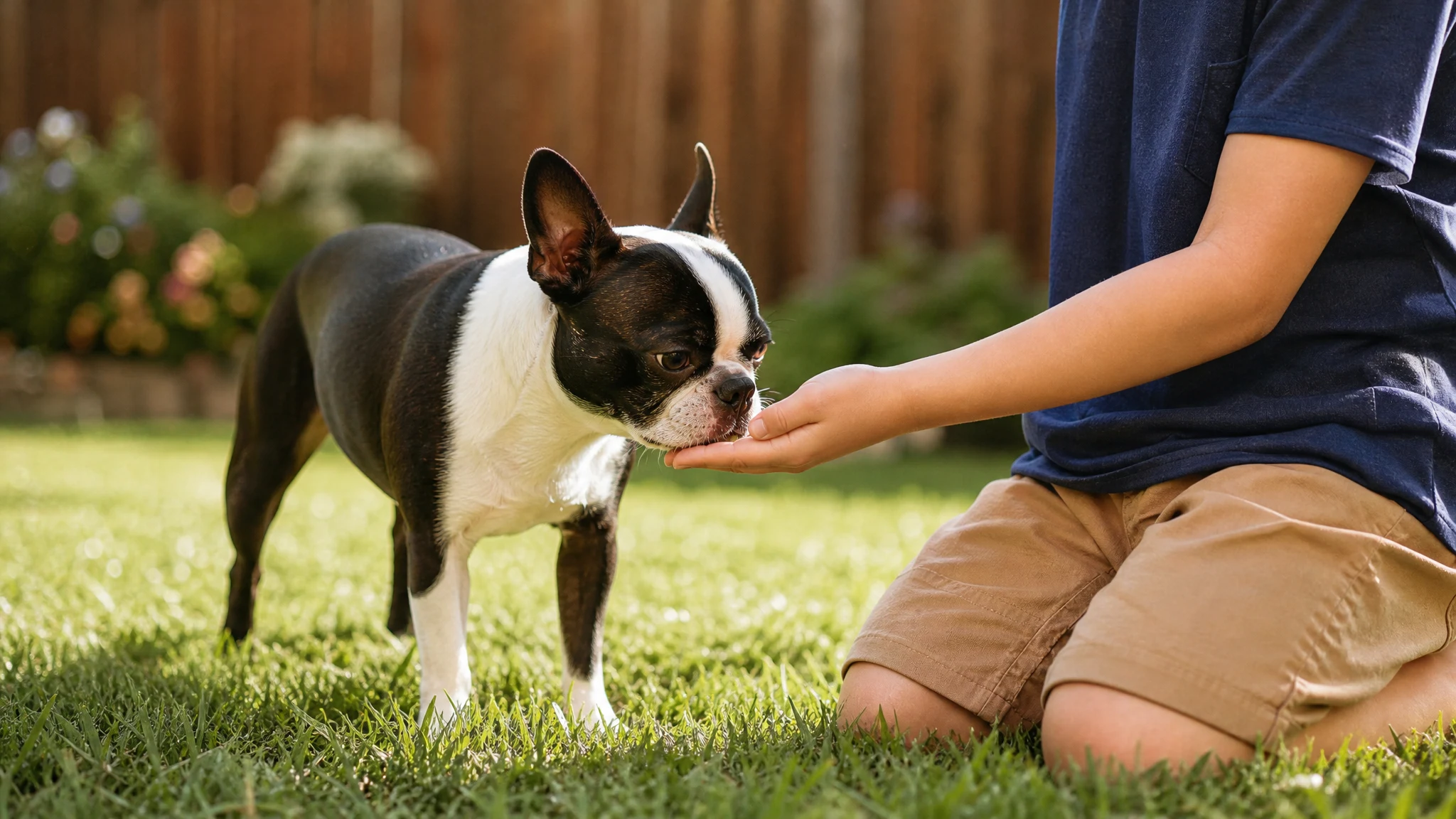
Ask visitors to ignore the dog at first. Have them stand or sit while you feed treats for calm behavior. Let your Boston choose to approach. When the dog does, the visitor can offer a treat from a flat, low hand and pet the chest or shoulder instead of reaching over the head.
Teach guests the one rule that matters: four paws on the floor earns attention. If your dog jumps, the person turns away calmly and tries again when the dog sits. Never punish; simply withhold the reward and then pay generously for the right choice.
Step 4: Set up safe meetings with children
Start with one calm, older child and a relaxed dog. Keep the first meetings short.
- Have the child sit on the floor or a couch while you hold the leash or keep the dog nearby.
- Let the child toss treats gently near the dog, then hand-feed treats on a flat palm.
- Teach the child to pet slowly on the chest or side, for two or three seconds, then stop and see whether your dog asks for more.
- End the session while the dog is still enjoying it.
An adult must be within arm's reach whenever a dog and a child are together. Teach kids not to grab, hug tightly, climb on, chase or disturb the dog while eating, chewing or sleeping. Give your dog a gated or crated place where children are not allowed.
Watch for signs of stress: turning away, lip licking, yawning, a stiff body, showing the whites of the eyes or sudden hiding. End the interaction calmly and give the dog space. If you see growling or snapping, contact a qualified, reward-based trainer or your veterinarian.
Step 5: Introduce other dogs gradually
The BTCA says Bostons generally do well around other pets, but it does not single out other dogs, so treat Boston Terrier interactions with other dogs as something to build, not assume. Check with the club if you want guidance on dog-to-dog behavior in the breed.
- Parallel walks. Walk with a calm, vaccinated, known dog at a distance that lets both dogs stay relaxed. Close the gap a little each outing.
- Short greetings. Allow a brief, loose-leash sniff for a few seconds, then call your dog away and reward.
- Controlled play. Use a fenced area with one well-matched dog. Take breaks every few minutes. Healthy play looks bouncy and mutual, with role swaps and pauses.
- Add variety. Over time, meet different sizes and ages, always one at a time.
Avoid crowded dog parks early on. A single bad experience can undo a lot of good work. Choose play partners with good manners over whoever happens to be nearby.
Step 6: Practice in the real world
Visit quiet streets, outdoor cafes with permission, pet-friendly store entrances and friends' homes. Keep each outing short. Bring water and avoid hot, humid hours, because PetMD flags heat and humidity as a risk with exertion for this flat-faced breed. If your dog is panting hard or noisy in the breathing, stop, cool down and call your vet.
Step 7: Teach calm, then repeat
Socialization is not only about meeting everything. Practice settling on the mat while people talk, kids play and dogs walk by. Reward calm. A Boston who can relax around activity is easier to live with than one who has only learned excitement.
Repeat the steps in small doses over weeks and months. Your dog's comfort will keep changing as they mature, so keep up positive exposure throughout adulthood.
Tips for Better Results
- Keep sessions short and upbeat. Stop before your dog is tired or overexcited.
- Reward the calm moment. Pay for sitting, looking at you and relaxed body language.
- Use a leash. It gives you control without force.
- Give human contact daily. The BTCA notes the breed does poorly without it, and a lonely dog is often a pushier one.
- Be the dog's advocate. It is fine to tell people "no, thank you" when your dog is not ready.
- Exercise in bursts. PetMD recommends several short bouts through the day, which also helps keep greetings calmer.
Common Mistakes to Avoid
- Flooding. Dragging a nervous dog into a crowd teaches fear, not confidence.
- Letting jumping pay off. If strangers reward jumping with cuddles, your dog learns to keep doing it.
- Ignoring nipping. Play nipping is common without training, according to the BTCA. Redirect to a toy and reward gentle mouths.
- Leaving kids and dogs alone. Even a friendly dog needs an adult to step in.
- Using harsh methods. The American Veterinary Society of Animal Behavior (AVSAB) supports reward-based training. Avoid shock, prong or choke collars, alpha rolls, scruffing and dominance methods. They can increase fear and make behavior worse.
- Overdoing it in warm weather. Heat and the breed's flat face are a bad mix for long outings.
- Assuming breed reputation equals your dog. Watch the dog in front of you.
What Results to Expect
With steady, positive practice, many owners see their Boston settle faster around visitors, wait for permission to greet and recover more quickly from surprises. Progress may come in small steps, with good days and off days. Results vary by dog, history and consistency, and no plan can promise a particular outcome.
A realistic goal is a dog who can stay relaxed and respond to your cues around people, children and other dogs. If your dog shows persistent fear, growling, snapping or other worrying behavior, ask your veterinarian to rule out pain or illness and consider a qualified trainer who uses reward-based methods.