How Much Exercise Does a Boston Terrier Need? Plus Brain Games
General training information. Every dog is an individual; for health or behavior concerns, see your veterinarian.
Ask ten owners how much exercise a Boston Terrier needs and you will hear ten answers. The honest one is that it depends on the dog, the weather and the dog's health. This guide gives you a routine you can adjust, built on what the breed's parent club and a veterinary reference say.
The short version: Boston Terriers are lively, but their flat faces mean exercise should come in short bursts, not long, hard sessions. Pair that with daily mental work and most owners find a calmer, more settled dog at home. Individual dogs vary, so treat everything here as a starting point.
What the Breed Sources Say About Exercise
The Boston Terrier Club of America (BTCA) describes the breed as very active and playful. The club also calls Bostons companion dogs that need human contact and are not outdoor dogs. They have been bred to be companions, and the BTCA says they will languish without time with their people.
PetMD, a veterinary reference, recommends several short bursts of exercise through the day. It also advises extra care in heat and humidity because of the breed's breathing. PetMD lists brachycephalic airway syndrome among the health issues seen in the breed.
Put those together and you get a clear picture. This is a dog that wants to play and be near you, but whose body does not do well with long, hot or intense efforts. Several small sessions suit that better than one big one.
The sources I relied on do not give an exact number of minutes per day, and they do not give puppy exercise limits. For those, ask your veterinarian. They can judge your dog's age, weight, joints and airway.
What You Need
- A well-fitted harness and a standard leash. A harness avoids pressure on the neck, which matters for a breed with airway concerns.
- Fresh water for every outing.
- Small, soft treats your dog loves, or part of the daily meal measured out for training.
- A puzzle feeder, snuffle mat or lick mat. A muffin tin and tennis balls also work as a home-made puzzle.
- A few toys for tug and fetch, sized for a small dog.
- A cool, shaded spot to rest, and a plan for hot days (indoor play, early morning or late evening outings).
Step 1: Check With Your Veterinarian First
Before you build a routine, ask your veterinarian how much activity suits your dog right now. This matters most for puppies, seniors and any dog that snores loudly, tires fast or struggles to breathe after light play.
PetMD lists eye problems, brachycephalic airway syndrome and patellar luxation among the concerns in the breed. Any of these can change what is safe for your dog. Only a veterinarian can say whether they apply to yours. If you see labored breathing, collapse or a limp, stop and call your vet.
Step 2: Split Exercise Into Short Bursts
Instead of one long walk, spread movement across the day. A sample pattern might look like this:
- A calm morning walk at an easy pace.
- A few minutes of indoor play or a training game at midday.
- A short game of fetch or tug in the afternoon.
- An evening stroll, followed by a puzzle feeder or chew.
Keep each session short enough that your dog finishes happy and breathing easily, not panting hard and flopping down. If you are unsure how long that is, your vet can suggest a starting point. Watch your dog, not the clock.
Step 3: Adjust for Life Stage
Puppies
The sources I used do not state specific exercise limits for Boston Terrier puppies. Because young dogs are still growing, ask your veterinarian what is safe for your puppy's joints before you add long walks, jumping games or stairs. Short play, gentle outings and early training are usually a good fit, but confirm with your vet.
Puppyhood is also when the BTCA's warning about jumping up and play nipping becomes real. The club notes these habits show up without basic training. Mental work and short training games give a puppy something better to do with that energy.
Adults
Healthy adults are where the "very active and playful" description fits best. Aim for the several-bursts pattern from Step 2, plus daily brain work. Adjust up or down based on how your dog behaves in the evening. A dog that paces, chews or nips at you may need more play or more mental effort. A dog that gets noisy breathing or stays tired may need less.
Seniors
The BTCA gives an average lifespan of around 11 to 13 years, and says a healthy, well-kept Boston can live well into the teens. As your dog ages, shorter and gentler sessions usually make sense, and mental games become even more valuable. Your veterinarian can advise on joint comfort and stamina. Do not give any medication or supplement without their direction.
Step 4: Plan for Heat and Humidity
This step can matter more than any other. PetMD advises extra care in heat and humidity because of the breed's breathing. A flat face makes cooling harder.
- On warm or muggy days, move walks to early morning or late evening, or swap them for indoor games.
- Bring water and offer it often.
- Walk on grass or shade when pavement is hot.
- Never leave your dog in a parked car.
- Stop at the first signs of heavy panting, drooling or reluctance to move, and get to a cool place. Call your veterinarian if your dog does not recover quickly.
Step 5: Add a Sniff Walk
A sniff walk is one of the easiest ways to improve Boston Terrier mental stimulation without adding physical strain. Instead of marching at a set pace, you let your dog stop and investigate. Sniffing is mentally tiring for dogs, and it keeps the pace gentle.
- Clip the leash to the harness and pick a quiet, shaded route.
- Let your dog choose where to sniff, within reason. Keep the leash loose.
- Pause whenever your dog pauses. Treat the walk as time to explore, not distance to cover.
- Use a cue such as "let's go" and a treat to move on when you need to.
- Finish with a drink of water and a rest.
Some owners find a short sniff walk settles their dog as well as a longer, faster one. Results vary, and a sniff walk does not replace play. It adds to it.
Step 6: Use Puzzle Feeders and Food Games
Bostons are described as intelligent, quick learners by the BTCA. That brain needs a job. Meals are a handy place to give it one.
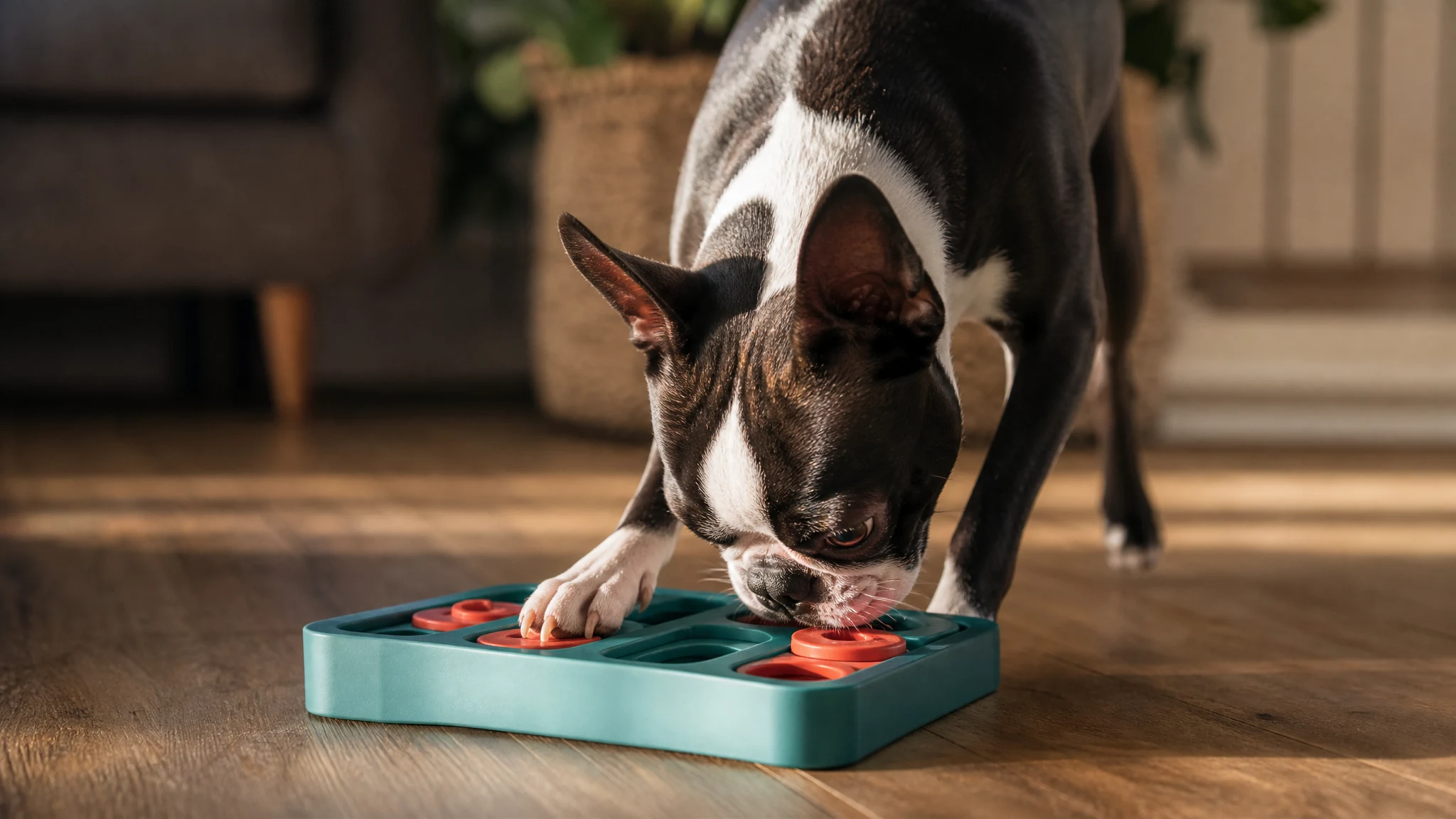
- Puzzle feeder: Put part of a meal in the toy and let your dog work it out. Start with an easy setting so your dog wins early.
- Snuffle mat: Scatter kibble in the folds. It slows eating and rewards sniffing.
- Muffin tin game: Place treats in a few cups and cover them with tennis balls. Your dog nudges the balls away to find the food.
- Scatter feeding: Toss a handful of kibble onto a rug or lawn and let your dog hunt for it.
Count these calories as part of the daily meal so weight stays steady. Ask your vet how much your dog should eat. Always supervise, and take away any toy your dog starts to chew apart.
Step 7: Play Training Games That Use Your Company
The BTCA says Bostons were bred to be companions. That is the closest thing to an "original job" in the sources, so the best brain games are the ones you do together. PetMD notes the breed responds well to positive reinforcement, and that patience and games help with their independent streak. That fits the reward-based approach recommended by the American Veterinary Society of Animal Behavior.
Try these:
- Name game: Say your dog's name in a happy tone. When your dog looks at you, reward right away. Repeat in different rooms.
- Hide and seek: Have a helper hold your dog while you hide. Call once, then reward your dog warmly on arrival. This builds recall and uses the breed's wish to be with people.
- Find it: Show a treat, then toss it a short way away and say "find it." Gradually hide treats in easier spots, then harder ones.
- Trick of the week: Teach spin, shake or "touch" (nose to your hand). Reward small steps. Keep sessions brief and end on a success.
- Four on the floor: To work on jumping up, reward your dog only when all four paws are on the ground. Ignore the jump and turn away. Reward the moment the paws land.
Patience matters here. PetMD says the breed can have a mind of its own, so keep games upbeat, keep treats high value, and stop before your dog loses interest. For a full foundation, see our complete guide to Boston Terrier training.
Sample Day for an Adult Boston Terrier
| Time | Activity | Type |
|---|---|---|
| Morning | Easy sniff walk | Physical and mental |
| Breakfast | Snuffle mat or puzzle feeder | Mental |
| Midday | Short training game (name game, trick of the week) | Mental |
| Afternoon | Brief fetch or tug, indoors if warm | Physical |
| Evening | Calm stroll, then a chew or lick mat | Physical and calming |
This is a template, not a prescription. Change it to fit your dog, your climate and your vet's advice.
Tips for Success
- Keep sessions short and end while your dog still wants more.
- Rotate toys and puzzles so they stay interesting.
- Use part of the daily food as rewards.
- Include your dog in family time. The BTCA is clear that these dogs need human contact.
- Brush weekly. The BTCA says Bostons shed only a small amount and weekly brushing keeps it under control. It also makes a nice calm bonding moment after play.
Common Mistakes to Avoid
- One long, hard workout. It runs against the short-burst advice and can strain a flat-faced dog.
- Exercising in heat. Midday summer walks are a frequent problem for the breed.
- Using a collar for pulling. A harness is gentler on the neck. Never use shock, prong or choke collars. They conflict with reward-based training.
- Skipping brain work. A bored, under-challenged dog may turn to nipping, jumping or chewing. The BTCA lists jumping and play nipping as issues without basic training.
- Leaving the dog alone outdoors. The BTCA says the breed is not an outdoor dog.
- Ignoring warning signs. Noisy, labored breathing is a reason to stop and call your vet, not to push on.
- Forcing games. If your dog shuts down, make it easier and reward more often.
What Results to Expect
With a steady routine, many owners find their dog is calmer in the evening, more focused during training and less likely to chew or nip out of boredom. Some dogs also eat more slowly with puzzle feeders. These outcomes are not certain and vary from dog to dog. Age, health, past habits and temperament all play a part.
Give any new routine a few weeks before you judge it. If your dog still seems restless, anxious or unusually tired, talk with your veterinarian. They can rule out health causes. A qualified positive-reinforcement trainer can also help if behavior problems continue.
Quick Answer: How Much Exercise Does a Boston Terrier Need?
Based on the parent club and PetMD, a Boston Terrier needs regular, short bursts of activity through the day, extra care in heat and humidity, and plenty of time with people. Your vet can give you a duration that fits your own dog, especially a puppy or senior. Fill the rest of the day with sniffing, puzzle feeding and short, rewarding training games.